
A friend recently asked me, “What was the turning point for you? Like how did you make the decision that you were going to make this a lifestyle and just keep doing it day after day?” You know the old saying, “I’m sick of tired of being sick and tired?” That was me at the end of 2016. I didn’t know what to do, but I did know that I needed a change if I was ever going to feel better (physically and mentally). A friend had reached out to me about trying some at home workouts, and when I started using ” it’s too cold” as an excuse to skip the gym after I got home from work, I thought that might be a good way to stop talking myself out of workouts. There were all different types of workout programs with different workouts that took around 30 minutes to complete. The approach to eating was similar to what I had followed in the past in terms of certain amounts of protein, fat and carbohydrates, but the biggest difference is that there was a focus on fruits and vegetables as well as eating minimally processed foods. Though I was skeptical about whether or not this would work, at that point I felt like I had nothing to lose and the approach seemed like something I could realistically commit to and STICK to – work out 30 minutes most days of the week, and follow the portion sizes. “Okay. I can do this.”
So I did, for roughly six months. Month after month the pounds and inches kept dropping, my clothes were fitting more loosely, I had more energy than I had had in a LONG time, and I just down right felt good about myself. It felt so empowering to commit to something, be consistent and see results month after month. The smallest amount of progress was enough motivation to just continue putting one foot in front of the other (literally and figuratively) day after day. “Suffer the pain of discipline, or suffer the pain of regret” became my mantra. Yes, some days it was hard as hell to do a thirty minute workout and it was even harder to eat what I had prepared for myself according to my plan instead of diving head first into the Goldfish, animal crackers or whatever junky snack my kids were having at school for the day. But, every day was made up of tiny little moments where I was faced with a choice. I could choose to continue making ridiculous excuses to justify my current behavior, or I could suck it up and choose to do what I knew I needed to do. And after six months, I had lost over 15 pounds, almost back to what I weighed around the time of our wedding. But numbers aside, I was able put my wedding dress back on. I laced up every last button, and it didn’t immediately burst back open. I had arrived! This is what I had been wanting for SO long for and accomplishing this milestone made me feel unstoppable.
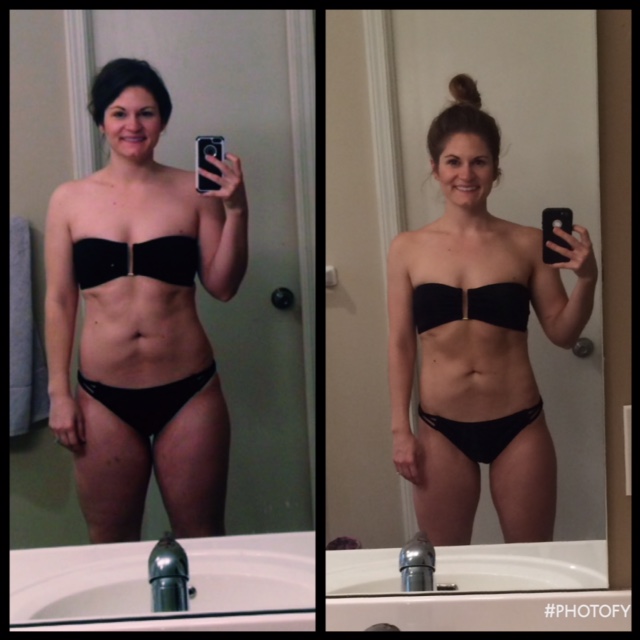
This photo shows physical differences in my body that took place from January through July of 2017. This was during the time I was taking monthly (if not more often) progress photos of myself. I rarely take these photos anymore, for reasons I’ll outline in my next post. I debated whether or not I should share this photo here because I feel like it negatively reinforces “smaller person = better person.” This is NOT true. I now know that I was an equally great person in both photos, though my health was at a different place in each one.
But what next? I knew I wanted to make this a lifestyle, and had made significant progress in doing so, but the motivation was still mostly related to my physical appearance for me at this point. After the weight was gone, I started regularly scrutinizing nearly every part of my body, and became borderline obsessed with my lean body composition and figuring out how to workout and eat to make it even more lean. Because the leaner the healthier, right? (I was surprised to learn later that that’s not necessarily true.) It felt like I just had to keep the hamster wheel spinning (eat right, workout, take the supplements, do more cardio, don’t eat that cake, and if I do I had better atone for it during the next workout…) because if I stopped, then surely I would lose everything I had worked so hard for. This is all I had ever known based on my past efforts – the inevitable rebound weight gain after making efforts in the kitchen and gym that weren’t sustainable for me. I had been so rigid and regimented in my approach up until now because I was honestly terrified of what would happen if I backed off a bit. But there finally came a point where I noticed my enthusiasm for my workouts was dwindling. They felt more like a chore instead of a time I enjoyed doing something good for myself like they did in the beginning. While I still had muscle definition, it seemed to have stopped progressing. My body (and heart) just seemed to be saying, “nope.” So I backed off a bit. And to my surprise, I didn’t gain 20 lbs after three consecutive rest days in a week! Whoa! (Sarcasm intended.) While I was having some ambivalent feelings about letting my foot off the gas just a bit with my workouts, my friend told me that she and her mom were considering doing a Whole30 after the New Year. Full disclosure, when I first heard this I rolled my eyes and thought, “I don’t need that.” Cutting out dairy, grains, legumes, sugar, and alcohol for THIRTY DAYS?! Thanks, but no thanks. Why is it so restrictive? Won’t that just make me want those things even more than I already do? There’s literally NO way I could ever do that. That’s not a sustainable lifestyle! But my belief in myself and my curiosity about real food nutrition had grown quite a bit over the past year and after giving it some thought, this started to sound like the perfect new challenge for me to set my eyes on (while taking my eyes off my body).
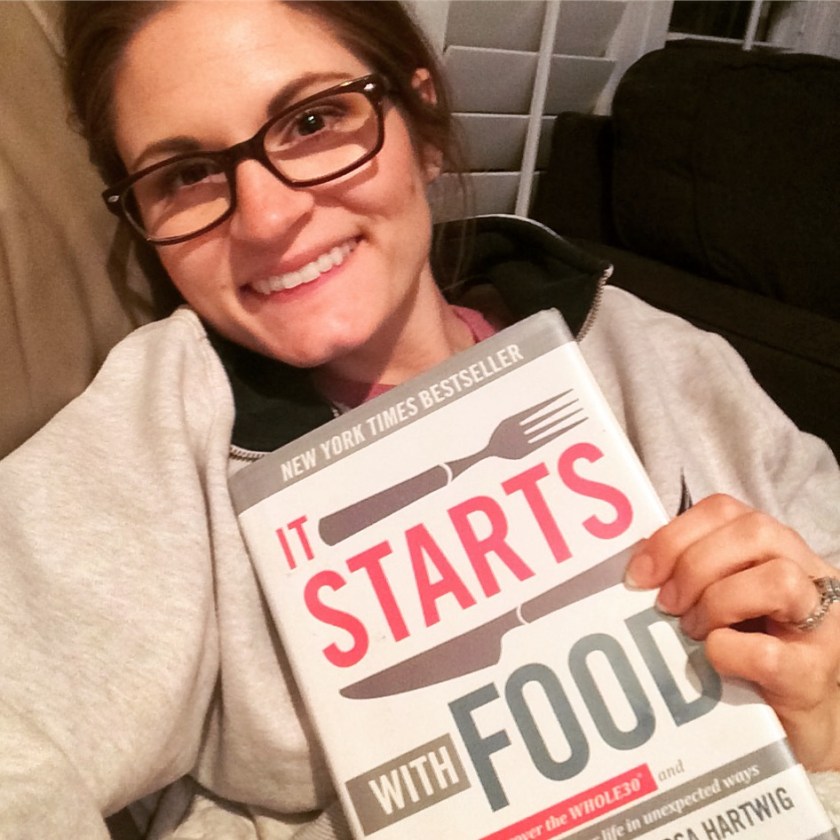
I had no idea that reading this book would not only be part of the beginning of my Whole30, but the beginning to a completely new chapter in my life.
In the months leading up to the New Year, I took some time to prepare myself. What is the Whole30? Why are these particular foods the ones that are eliminated? What’s a legume? I dug into Melissa Hartwig’s “It Starts With Food” and literally couldn’t put it down. I was FASCINATED with what I was learning. In short, the food groups that are eliminated for the thirty days *can* have negative impacts on our physical and psychological health and cause excess inflammation in our bodies. (Though not everyone has the same reaction to each food group.) You remove these foods to essentially rid your body of any negative impact they may be having and then at the end of the thirty days you reintroduce them one by one if it’s something you want to have back in your diet, that way you can experience the impact a particular food group is having on your body apart from any other factors. It’s kind of like a giant science experiment on your body. The most challenging part of this is that aside from fruits, vegetables and meat, almost anything you may use to create a recipe (sauces, seasoning, oils, sweeteners, thickening agents, etc.) is most likely not compliant or contains ingredients that aren’t compliant. You have to read labels LIKE A HAWK to ensure that you’re not accidentally consuming ingredients that aren’t compliant. What’s the big deal? It’s just a teaspoon of sugar. Well, the whole point of the Whole30 is to completely eliminate these food groups from your system because even a small amount can trigger a negative reaction in your body. And the compound effect of a little here and a little there can add up over thirty days. So if you’re still including these food groups, even in small amounts, you’re not actually doing a Whole30. It’s very black and white in this manner, which in some ways made it easier than other approaches to nutrition I’ve tried in the past that had flexibility. I didn’t have to think for thirty minutes about whether or not I was going to eat a cookie, because I literally couldn’t eat it if I didn’t want to start back over at day one.
Completing the Whole30 was a monumental milestone in my journey to optimal health. Because for the first time in my life, I was finally experiencing benefits of eating real, whole foods like getting the best sleep I have EVER had, sustained energy throughout the day, clear skin, no bloating, an improved relationship with food, etc. that were NOT related to my physical appearance. I don’t think I would have ever broken free of the mindset that I ate certain foods to look a certain way without this experience. It propelled me into the mindset of eating certain foods to FEEL a certain way. I think we all know that veggies are “good” for us and junk food is “bad,” but until I completely eliminated these foods (and their power over me), I didn’t really have any desire to stop eating them. Because… they taste GOOD! Right? Why would I ever NOT want to eat a cookie? I used to be so envious of people who turned down sweets when they were offered them and wondered how in the hell they could say no, because I sure couldn’t. Knowing they were “bad” wasn’t enough. Here’s the thing though. When we’re used to eating the foods that line 90% of the shelves at every grocery store, our bodies are literally addicted to these fake, highly artificially flavored, sweetened, colored foods (“Frankenfoods” as Melissa Hartwig calls them). When we eat them, our body is hard wired to tell us to eat more. And more. And more. What I didn’t realize until the Whole30 is that I could change my body’s (and my mind’s) reaction to food. Eating the standard American diet including many processed, nutrient-poor foods and snacking and grazing between meals, wrecks our blood sugar regulation, our hormones, and provides our bodies with little to no nutrients. But for thirty days I ate foods full of nutrients, learned what it felt like to feel full, and learned how to eat when I was actually hungry. And that’s when I realized that all these years it wasn’t just my “lack of will power” that had gotten me to where I was. There were so many other physiological factors that were telling me to “eat the cookie” when I saw one. It was liberating to know that I could FINALLY stop blaming my past self. It wasn’t my willpower that was working against me. It was science. And the fact that we can actually change that within our bodies? Wow. How powerful is that?

Another cool thing about the Whole30? Meals are viewed as meals, regardless of what time of day they occur. Breakfast doesn’t have to consist of “breakfast” foods. Cast iron cooked broccoli is now one of my favorite veggies to eat alongside eggs at breakfast. Did I ever think I’d regularly eat broccoli for breakfast? Nope. Thanks Whole30.
Eating a diet that’s primarily real, whole foods may sound nearly impossible and just flat out unattainable. I know it did for me. But it is possible to change your palate and learn to like foods that you may not like currently (looking at you, raw broccoli!) And no, I don’t eat this way 100% of the time. But I eat like this as much as possible because I know how good it feels. I also continue learning about how this way of eating is positively impacting my body, which makes it easier and easier to continue choosing real whole foods over the other alternatives.
I think it’s going to take me just one more post to get to what I’m currently practicing in terms of nutrition, working out, and how I got to this current state of mind with my approach. I continue to be amazed at how many lives my words are touching. If you have questions, follow up thoughts, or even just want someone to listen to your story, I’d be honored to be that person! Feel free to comment below or email me directly.
 Well With LB
What a great post! Loved it.
LikeLike